
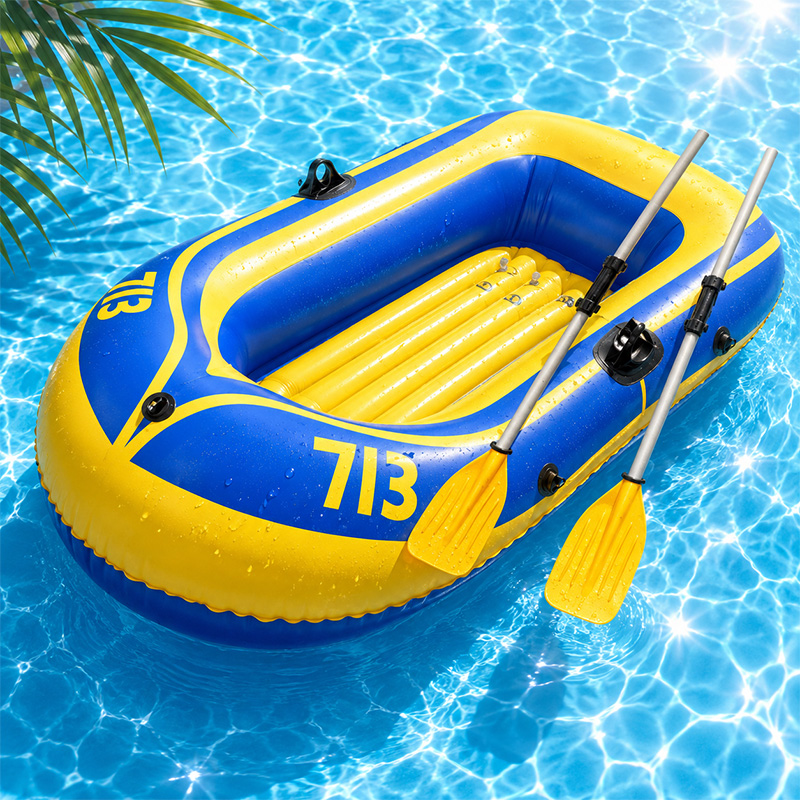
Inflatable camping and outdoor products occupy a different engineering space from water leisure items. They are inflated for repetitive use rather than continuous submersion, they are frequently packed and unpacked, and they must tolerate being placed directly on soil, gravel or paved ground. Those conditions shift the design priorities: air retention over a long evening becomes more important than burst strength, and puncture resistance against mineral edges becomes more important than chemical resistance to chlorinated water.
Air Retention versus Burst Strength
These two properties are often treated as a single quality indicator, which leads buyers to over-specify in the wrong direction. Burst strength is the pressure at which a chamber fails catastrophically; air retention is the rate at which pressure decays during normal use under no load.
A chamber can have excellent burst strength and poor air retention — a common outcome when a heavy sheet is welded with insufficient energy, producing a seam that holds at the moment of manufacture and creeps under sustained pressure. Conversely, a thinner sheet with a properly welded seam may lose less pressure overnight despite a lower burst rating.
For camping products, air retention is the property the end user actually experiences. A hammock that needs re-inflation after ninety minutes has failed regardless of its burst rating. When evaluating samples, an overnight inflation test — inflate to rated pressure, record the pressure after eight hours at room temperature — exposes more real quality than any destructive test.
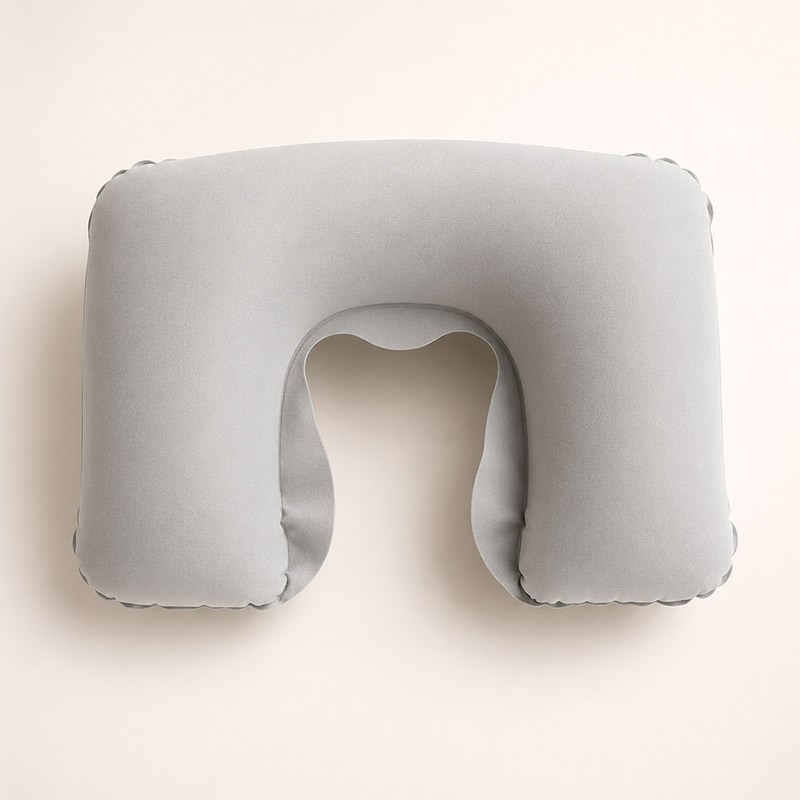
Ground-contact surfaces must resist mineral edges; the underside specification usually differs from the upper surface.
Load Rating and the Role of Chamber Geometry
Load rating for an inflatable seating or sleeping product is determined less by sheet thickness than by chamber geometry. A single large chamber distorts under load, pushing the user into a depression and concentrating stress at the seam perimeter. Dividing the same volume into two or three longitudinal chambers distributes the load, holds the surface flatter and reduces peak stress at any single seam.
Chamber geometry also governs how the product feels. Long, narrow chambers produce a firmer, more supportive surface suitable for seating. Shorter, wider chambers produce a softer surface better suited to lounging. Neither is superior in the abstract; the correct choice follows the intended posture.
Determining a defensible load rating
A load rating should always be stated together with the pressure it assumes. The rated pressure for inflatable furniture typically sits between 0.3 and 0.8 psi; increasing pressure raises load capacity but also raises seam stress. A supplier quoting a load figure without a corresponding pressure has not provided a specification. Buyers should ask for both, and for the test method used.
Ground contact design
The surface in contact with the ground is a distinct specification from the surface the user touches. Ground contact demands abrasion resistance and cut resistance against gravel, twigs and rock. The user-facing surface demands a comfortable hand feel and printability. Using the same sheet for both is a cost compromise that shortens service life. Products intended for repeated outdoor deployment should specify a heavier, harder-wearing sheet for the base.
Pet Bath Tubs: A Category with Its Own Constraints
Inflatable pet bath tubs illustrate how application changes the specification. The requirements differ meaningfully from a human bathing product.
| Requirement | Reason | Specification implication |
|---|---|---|
| Puncture resistance | Claws and teeth impose concentrated point loads | Heavier base sheet; reinforced rim and corner welds |
| Slip resistance | An animal shifting its weight can destabilise the tub | Textured or dimpled floor surface |
| Drainage | Water must be emptied without lifting the filled tub | Integral drain plug positioned at the true low point |
| Chemical tolerance | Shampoos and flea treatments are more aggressive than plain water | Stabiliser system selected for surfactant exposure |
| Wall height | Must contain the animal while allowing the owner to reach in | Height balanced against access, not maximised |
The drainage specification deserves particular attention. A drain plug placed at the geometric centre of the floor will not empty a tub that sags when filled; the true low point under load is where the plug belongs. Buyers should confirm plug placement on a filled sample rather than on a drawing.
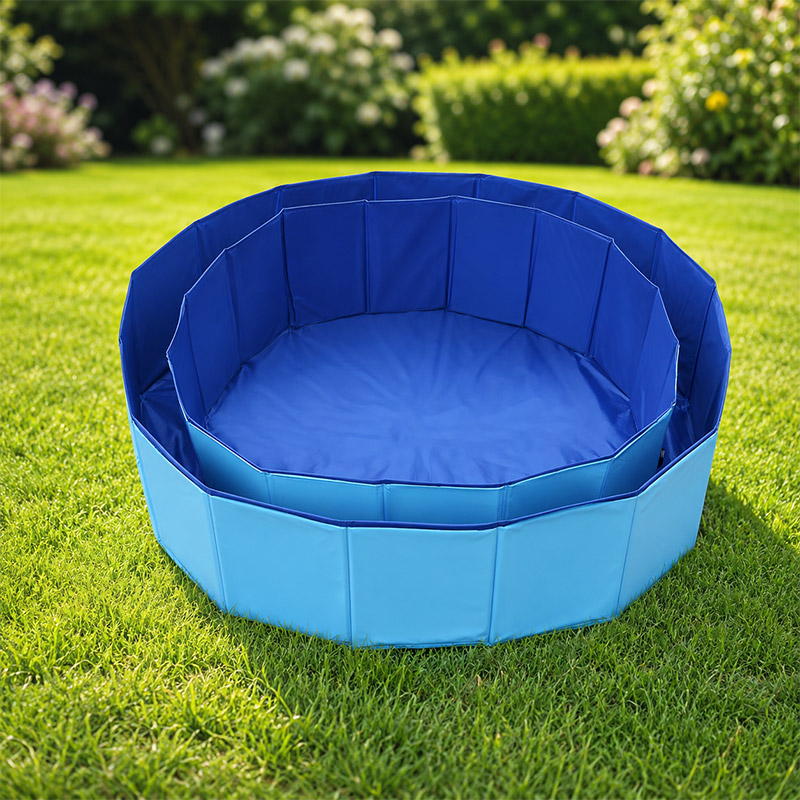
Drain plug placement should be verified on a filled sample, where the loaded floor shape differs from the unloaded drawing.
Climate Suitability and Cold-Weather Behaviour
Inflatable outdoor products sold into cold markets present a failure mode that warm-market buyers often overlook. PVC stiffens as temperature falls, because the plasticiser that provides flexibility loses mobility. A product that feels appropriately supple at 25 °C can become rigid and crack-prone at −5 °C, particularly at fold lines created during transport.
Three mitigations are available, and they can be combined:
- Raise the plasticiser content for cold-market SKUs, accepting a slightly softer product in warm conditions.
- Select a plasticiser with better low-temperature performance, which raises material cost modestly.
- Design fold lines and stress points with a larger radius so that stiffening does not concentrate at a sharp crease.
Because Jinhua Zongjin Toys serves export markets across several climate zones for its outdoor sports and camping lines, we routinely discuss destination climate as an input to the material specification rather than treating it as a commercial detail. A product specified correctly for a temperate market may be entirely unsuitable for a northern one, and the cost difference between the two specifications is generally smaller than the cost of a returned shipment.
Outdoor Inflatable Toys: Safety-Led Specification
Inflatable toys intended for children carry the strictest requirements of any product in this category, because the failure modes have safety consequences rather than merely commercial ones. Buyers in this segment should treat the following as non-negotiable specification items.
- Chamber independence. A child’s buoyancy aid or play product must not rely on a single chamber for flotation. Independent chambers with separate valves allow partial failure without total loss of function.
- Valve security. Valves must resist being opened by a child. Non-return valves combined with a cap that requires deliberate action are the appropriate default.
- Material non-toxicity. Plasticisers and stabilisers must comply with the destination market’s toy safety regime. This is a documentation requirement, not a descriptive one.
- Edge and corner finishing. Welded seams should be trimmed and finished so that no hard bead or sharp edge is exposed.
- Warning marking durability. Printed safety warnings must survive the product’s expected life, including abrasion and water exposure.
Assembling a Complete Outdoor Range
Buyers building a coherent outdoor range generally benefit from consolidating fabric specifications across SKUs. Running two or three sheet weights across a family of products — a light weight for toys and small accessories, a mid weight for seating and tubs, a heavy weight for ground-contact bases — reduces tooling changeover, simplifies quality control and lowers unit cost without compromising any individual product’s suitability.
| Product class | Recommended sheet weight | Primary property |
|---|---|---|
| Children’s outdoor toys | Light (250–350 g/m²) | Soft edges, low weight, printability |
| Pet bath tubs | Mid to heavy (450–600 g/m²) | Puncture resistance, floor stability |
| Camping hammocks and seating | Mid (400–500 g/m²) | Air retention, load distribution |
| Ground-contact bases | Heavy (550–650 g/m²) | Abrasion and cut resistance |
Outdoor inflatable toys and outdoor sports products are two of the six categories we manufacture, alongside PVC products, children’s toys, car accessories and water leisure products. Consolidating an outdoor range across those categories under a single material strategy is the most reliable way to control both quality and landed cost.