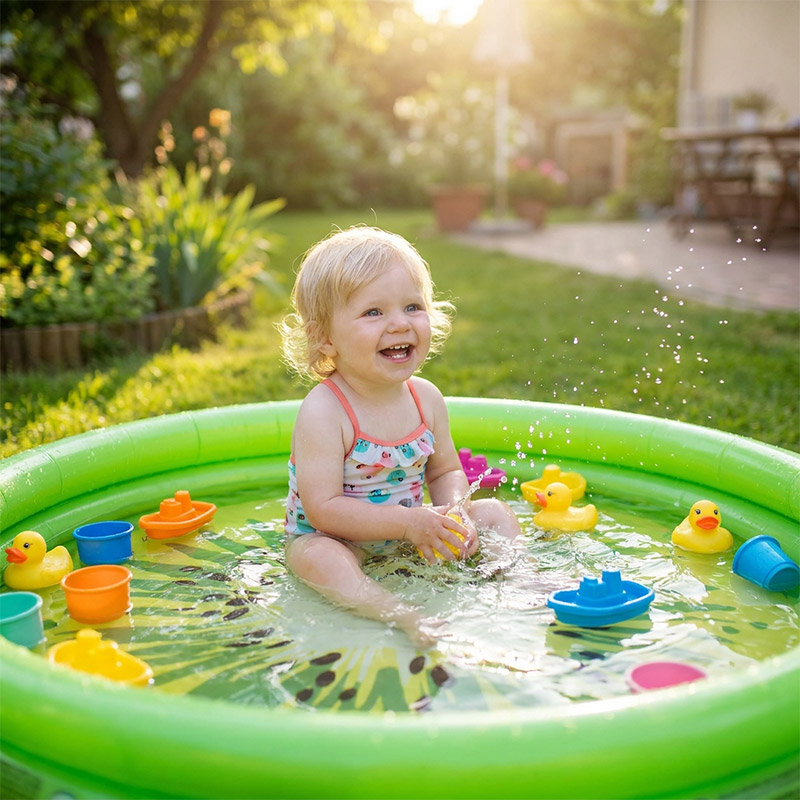
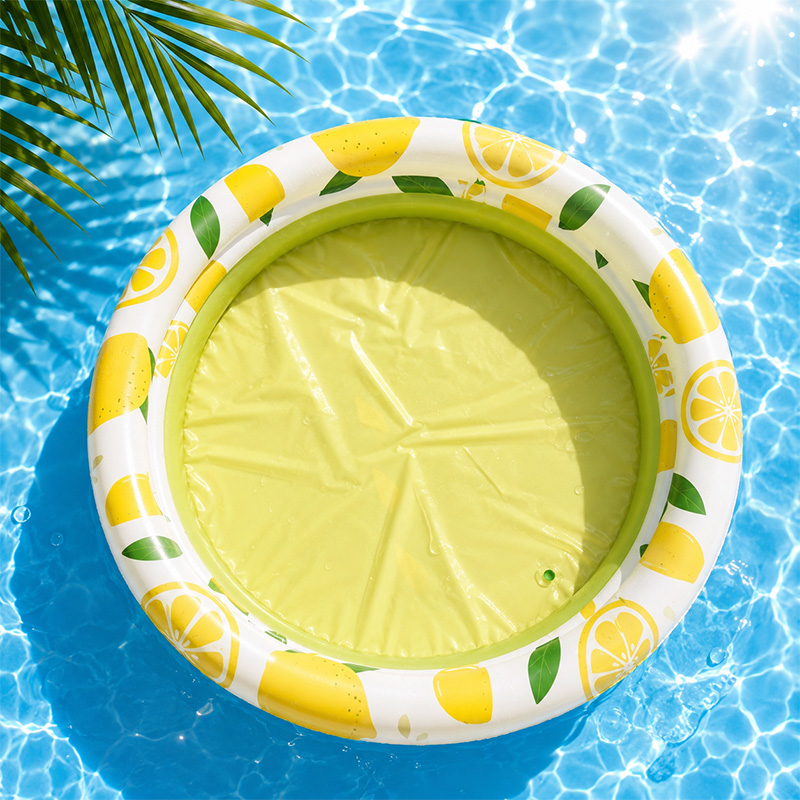
Every inflatable water product is a pressure vessel made of flexible fabric. The performance difference between a pool that survives three summers and one that fails in a single season is almost entirely decided before assembly begins — in the choice of PVC compound, the fabric weight, the seam method and the valve assembly. This guide explains those four decisions in the order a specification is written, so that a buyer can read a supplier’s technical sheet and know what each number actually controls.
Why PVC Is the Default for Water Leisure Products
Polyvinyl chloride is not chosen for water leisure products because it is the cheapest polymer available, but because it occupies a useful middle ground. Compared with polyethylene, PVC accepts plasticiser readily, which turns a rigid polymer into a flexible sheet without losing tensile strength. Compared with polyurethane, it bonds reliably to itself under radio-frequency welding, which is the process that gives an inflatable its airtight seams.
That combination — flexible when plasticised, weldable when heated — is what makes a leak-free chamber possible at a manufacturable cost. The trade-off is that PVC requires careful stabilisation. UV exposure and the plasticiser migration that follows high summer temperatures will embrittle an unstabilised sheet within a single season, which is why the additive package matters as much as the resin itself.
Reading a PVC Specification: The Four Numbers That Matter
A supplier specification for water leisure PVC typically lists four parameters. Buyers who evaluate only the first one routinely overpay for thickness while under-specifying the properties that actually govern service life.
| Parameter | Typical range | What it controls |
|---|---|---|
| Fabric weight | 250–650 g/m² | Puncture resistance and overall stiffness; the primary cost driver |
| Sheet thickness | 0.25–0.70 mm | Abrasion tolerance and weld bead stability |
| Plasticiser content | 25–45 phr | Flexibility at low temperature versus long-term rigidity |
| Stabiliser system | Ca-Zn / Ba-Zn | UV and thermal ageing resistance; migration resistance |
Fabric weight sets the durability ceiling
Fabric weight is quoted as grams per square metre for the coated sheet, not for the reinforcing scrim alone. A 250 g/m² sheet is appropriate for a low-cost swim ring intended for a single season of light use. A 650 g/m² sheet appears in rafting boats and in pools that will be dragged over rough ground. Increasing weight increases puncture resistance roughly linearly but also increases packed volume and freight cost, so the correct weight is the lowest one that matches the product’s expected abuse.
Thickness and weight move independently
Two sheets of equal weight can differ in thickness if the scrim density differs. A denser reinforcing grid allows a thinner coating to reach the same weight, producing a sheet that is stiffer and less prone to sagging over time but marginally less forgiving of sharp point loads. For pool floors, where the load is distributed, the denser-scrim option is usually the better engineering choice. For wall panels, where abrasion dominates, a thicker coating on a lighter scrim is preferable.
Plasticiser content is a climate decision
Plasticiser content is expressed in parts per hundred resin (phr). Higher content yields a softer, more pliable hand feel that performs well in cold conditions. Lower content produces a firmer sheet that resists migration better. Because migration accelerates with temperature, the correct specification depends on the destination market: a product destined for a hot, humid climate benefits from a lower plasticiser content paired with an effective stabiliser, whereas the same product sold into a temperate market can carry a higher content without sacrificing service life.
PVC wall construction in an inflatable pool — the reinforcing scrim is visible through the coating.
Seam Construction: Where Leaks Actually Originate
Leaks in inflatable water products concentrate at seams and valves far more than at the sheet surface. Three joining methods are common, and each carries a different failure mode.
- Radio-frequency (RF) welding. A high-frequency field heats the plasticiser in overlapping PVC layers, fusing them into a single mass. This produces the strongest and most airtight seam and is the standard for pools, boats and any chamber holding sustained pressure.
- Thermal (hot-air) welding. A directed hot-air jet softens both surfaces before they are pressed together. Suitable for large panels and geometries that are awkward for a press, but the seam quality depends heavily on operator control of temperature and dwell time.
- Adhesive bonding. Appropriate for low-stress trim and accessory attachment. Adhesive seams are the weakest of the three and should not be relied on for pressure retention.
When evaluating a sample, a straight-pull test on a seam strip reveals more than a visual inspection. A well-made RF seam will typically fail in the sheet material adjacent to the seam rather than at the seam line itself; a seam that separates cleanly at the joint indicates insufficient welding energy.
Valve Design and Inflation Behaviour
The valve is the component most likely to draw a consumer complaint, because it is the only part that interacts with the user every time the product is used. Three specifications determine whether a valve performs well over its life: the valve body material, the closure mechanism, and the sealing face.
- Body material. A valve body moulded from a grade matching the sheet’s plasticiser system bonds to the wall without a compatibility layer, avoiding the slow leak that develops when dissimilar plastics are joined.
- Closure mechanism. A screw-in cap offers the most reliable seal but requires the user to seat it correctly. A push-in plug is faster to operate and more tolerant of casual use, at the cost of a slightly higher leak rate if debris settles on the sealing face.
- Sealing face. A moulded sealing face with a defined compression land holds air more consistently than a flat face relying on cap torque alone.
Matching Material to Product Type
The table below maps the three principal water leisure categories to a defensible starting specification. These are starting points for quotation, not fixed rules — the destination market and expected use cycle should always be applied as modifiers.
| Product | Fabric weight | Seam method | Design priority |
|---|---|---|---|
| Swimming ring | 250–350 g/m² | RF weld | Light weight, low packed volume, comfortable hand feel |
| Inflatable pool | 400–550 g/m² | RF weld | Puncture resistance, floor stability, wall rigidity |
| Rafting boat | 550–650 g/m² | RF weld + reinforced stress points | Abrasion tolerance, multi-chamber safety, high pressure retention |

Multi-chamber construction in a rafting boat; independent chambers are the primary safety specification.
Chamber Count as a Safety Specification
For any product carrying a person over water, chamber count is not a feature — it is the safety case. A single-chamber design loses all buoyancy from a single puncture. A two- or three-chamber design retains partial buoyancy and, critically, retains enough structure for the user to return to shore. Buyers serving markets with active consumer-product regulation should confirm the chamber count and the rated pressure for each chamber, and should obtain test documentation rather than accepting a description.
What to Request from a Supplier
A quotation for water leisure products is only meaningful when accompanied by the material specification it is priced against. Buyers evaluating offers from Jinhua Zongjin Toys or any comparable manufacturer should request the following as a standard package:
- Coated fabric weight and sheet thickness, stated separately
- Plasticiser content in phr and the stabiliser system used
- Joining method for every seam class on the product
- Chamber count and rated pressure per chamber
- Valve type, body material and sealing face design
- Ageing test conditions, if UV resistance is claimed
Because PVC products form one of our six core categories, alongside outdoor inflatable toys, children’s toys, outdoor sports products, car accessories and water leisure products, we hold specification documentation for each fabric we run. Requesting the sheet and comparing it against the intended use is the single most effective step a buyer can take to avoid a specification that looks adequate on paper but fails in the field.